
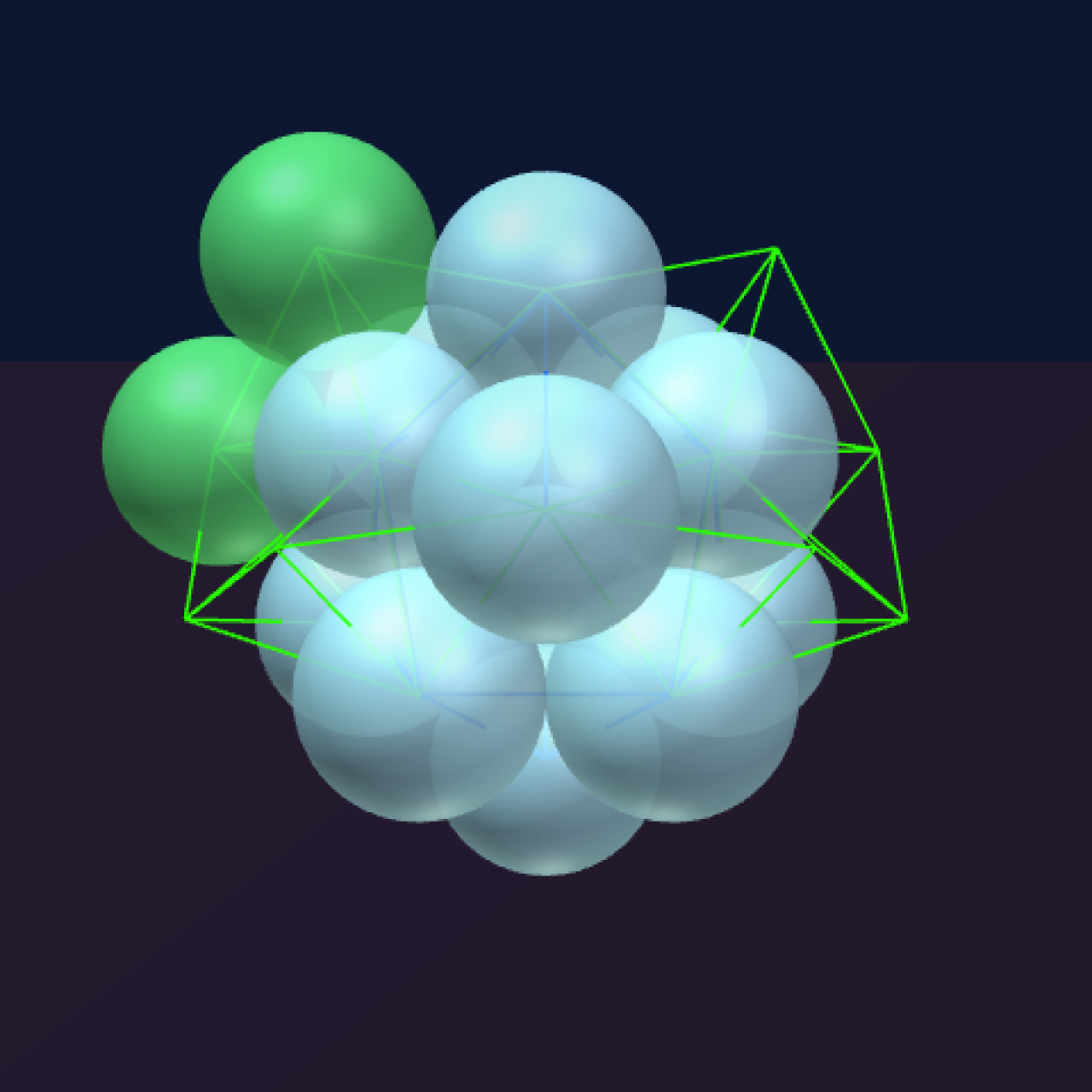
<p>This is the first element after Carbon (bigger then the Icosahedron) and it shows that the icosahedron is now "opened up" (the gap), This gap is responsible for the shape of further growth of the atom in the shape it does, doubling factor of carbon nuclets!</p>
<p>The "gap" is being supported on the 2 sides (left right) by perfect tetrahedron structures. The maximum number of tetrahedrons to support the opened up Carbon is 14. Essentially it is a distortion of the perfect icosahedron caused by growth. </p>
<p>Both sides have a potential of 2 connections making a total of 4. In the case of Nitrogen one of these connection points is capped by a deuterium nuclet / basic building block / neutron connection and this results in a total valence value of -3.</p>
<p>When the 2 extra protons connected to the structure in a tetrahedron are seperated, whereby one has its place on the left and one on the right side of the nucleus, then we speak of Carbon 14 in stead of Nitrogen 14.</p>
<p> </p>