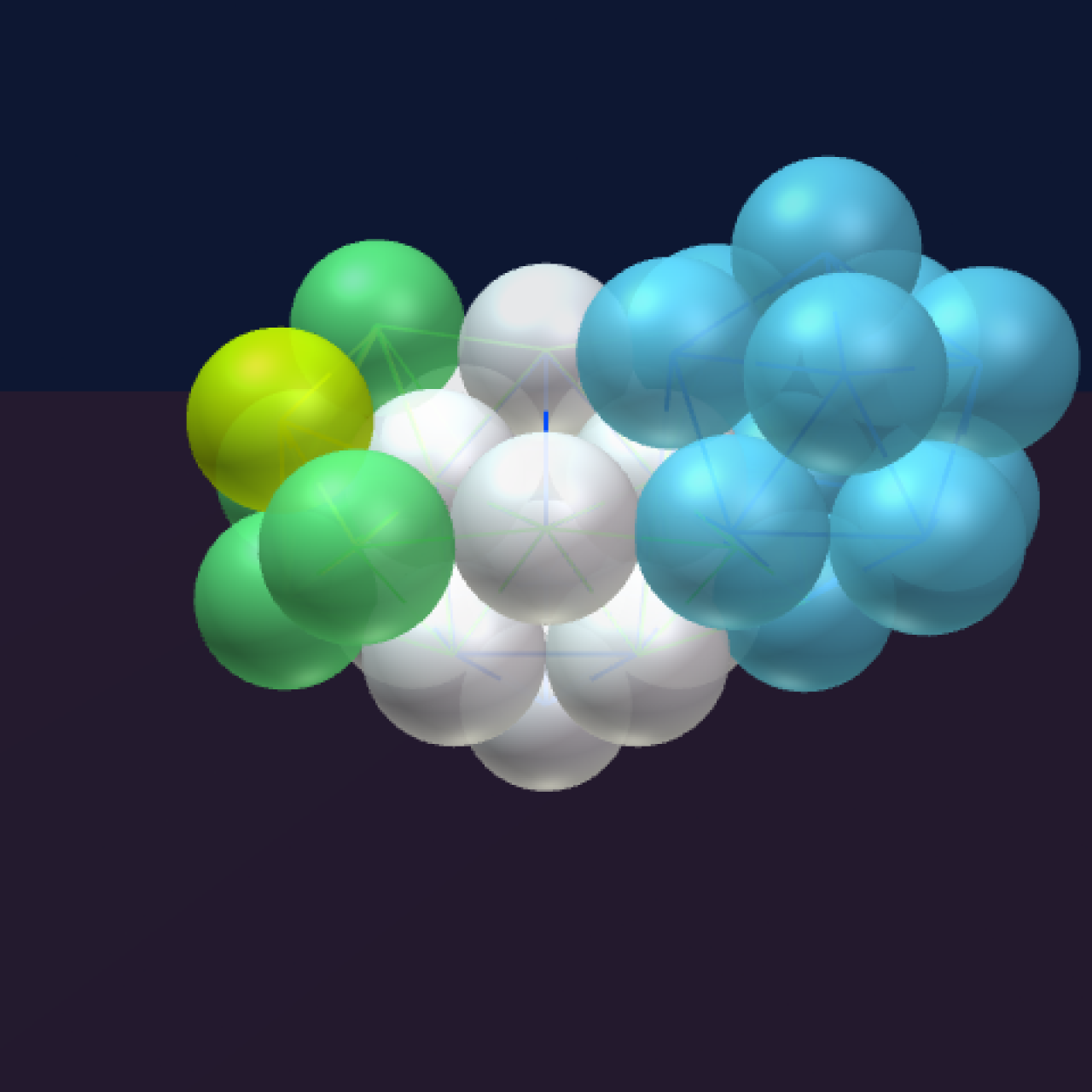
Silicon 28

Atom Image
Image
silicon-28.png
Name
silicon-28
Width
480
Height
480
File size
133586
# Inner electrons
14
# Outer electrons
14
# Protons
28
Abundance
92.22
An-Isotope
14: 28
Approval
Public
BE - Actual
236.54
BE - Nucleon
8447.74
BE - SAM Lines
235.85
BE - SAM Lines %
99.71
BE - SAM Nuclets %
0.00
Element
Half Life
Stable
Mass Actual
27.98
Mass Calculated
28.22
Mass H Norm
27.76
Nuclear Spin
0+
SAM Lines
182.45
Stability

<p>Silicon has an acitve carbon nuclet which results in a valence of +2/+4 and is essentially a Carbon with an extra backbone that has a neutral 5 ending. The half with the 5 ending is as if it were a noble&nbsp; gas, the half that has the Carbon nuclet is as if it were a Carbon. Therefore it falls into the so called Carbon group with similar properties as Carbon.&nbsp;</p>

<p>The Carbon nuclet can hold 2 potential extra 'neutrons' (p+e pair)&nbsp;yielding the Si 29 and Si 30 isotopes that are still stable.&nbsp;<br />
<br />
nb. Silicon has an alternative form, see element "Silicon 28 Alternative".&nbsp;<br />
Which combination of nuclets is dependent on the ratio of protons and neutrons (Deuterium pairs).&nbsp;<br />
In this case of Silicon, it seems that the alternative form is more true.&nbsp;</p>

<p>&nbsp;</p>

Atomic Structure
N0:
state: final
protons:
P0:
P1:
P2:
P3:
P4:
P5:
P6:
P7:
P8:
P9:
P10:
P11:
P12:
P13:
P14:
P15:
neutrons: [U00]
electrons:
E01: {protons: [P9, P0]}
E02: {protons: [P7, P11]}
E03: {protons: [P1, P4]}
E04: {protons: [P10, P3]}
E05: {protons: [P6, P2]}
E06: {protons: [P8, P5]}
E07: {protons: [P15, P14]}
E08: {protons: [P13, P12]}
nuclets:
N01:
state: carbon
attachAngle: 3
protons:
P0:
P1:
P2:
P3:
P4:
P5:
P6:
P7:
P8:
P9: {color: proton}
P11:
electrons:
E01: {protons: [P3, P11]}
E02: {protons: [P1, P4]}
E03: {protons: [P6, P2]}
E04: {protons: [P7, P0]}
E05: {protons: [P8, P5]}