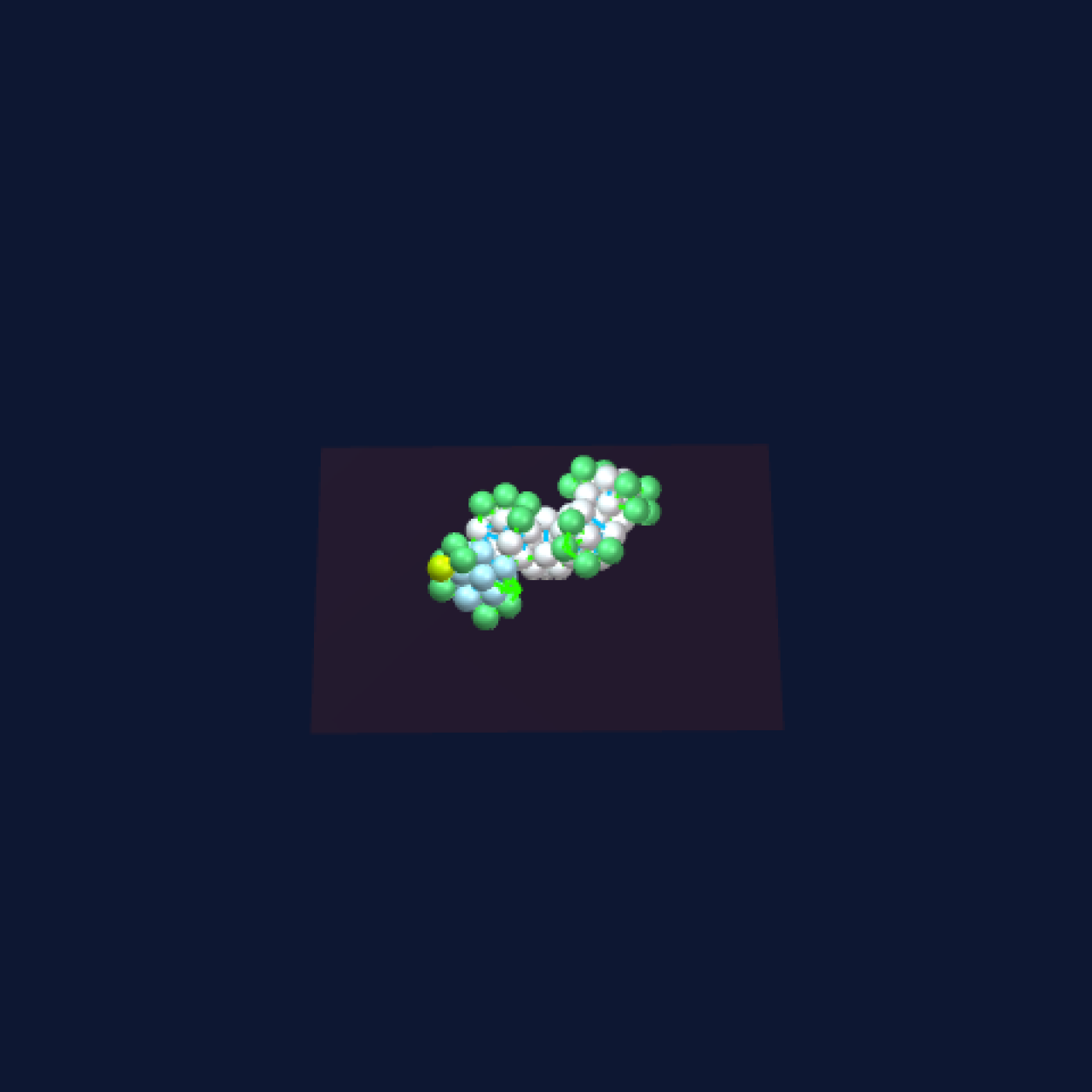
<p>Br79</p>
<p> </p>
<p>2 missing protons on the two inner 5 rings that support the backbone seem to be able to be a 4 ring when the outer branch has enough strength through another 5 ring. The outer 5 ring seems to prevent the proton movement of the neutral endings and active nuclets, "like a stick in a wheel"</p>
Atomic Structure
N0:
state: final
protons:
P0:
P1:
P2:
P3:
P4:
P5:
P6:
P7:
P8:
P9:
P10:
P11:
outerIcosaFaces: []
nuclets:
N00:
state: final
attachAngle: 3
protons:
P0:
P1:
P2:
P3:
P4:
P5:
P6:
P7:
P8:
P9:
P11:
P16:
P17:
P18:
P19:
outerIcosaFaces: []
nuclets:
N000:
state: initial
attachAngle: 3
protons:
P0:
P1:
P2:
P3:
P4:
P5:
P6:
P7:
P8:
P9:
P11:
P12:
P13:
P16:
P17:
P18:
P19:
neutrons: [U10]
outerIcosaFaces: []
N01:
state: final
attachAngle: 3
protons:
P0:
P1:
P2:
P3:
P4:
P5:
P6:
P7:
P8:
P9:
P11:
P16:
P17:
P18:
P19:
outerIcosaFaces: []
nuclets:
N010:
state: final
attachAngle: 3
protons:
P0:
P1:
P2:
P3:
P4:
P5:
P6:
P7:
P8:
P9:
P11:
P12:
P13:
P14:
P15:
P16:
P17:
P18:
P19:
outerIcosaFaces: []
Notes
<p>Branching is an 'issue' from Br onwards. <br />
It is difficult to discern which next branch grows first. </p>
<p>If this is a different branch than the one seen here, then all the underlying elements will chance accordingly. </p>
<p>This has no effect on the number of lines (bonds) or nuclets composition, it does effect the larger whole and this is still a research topic as off april 20 - 2019</p>
<p>--</p>
<p>P SAM 38</p>
<p>N SAM 41</p>