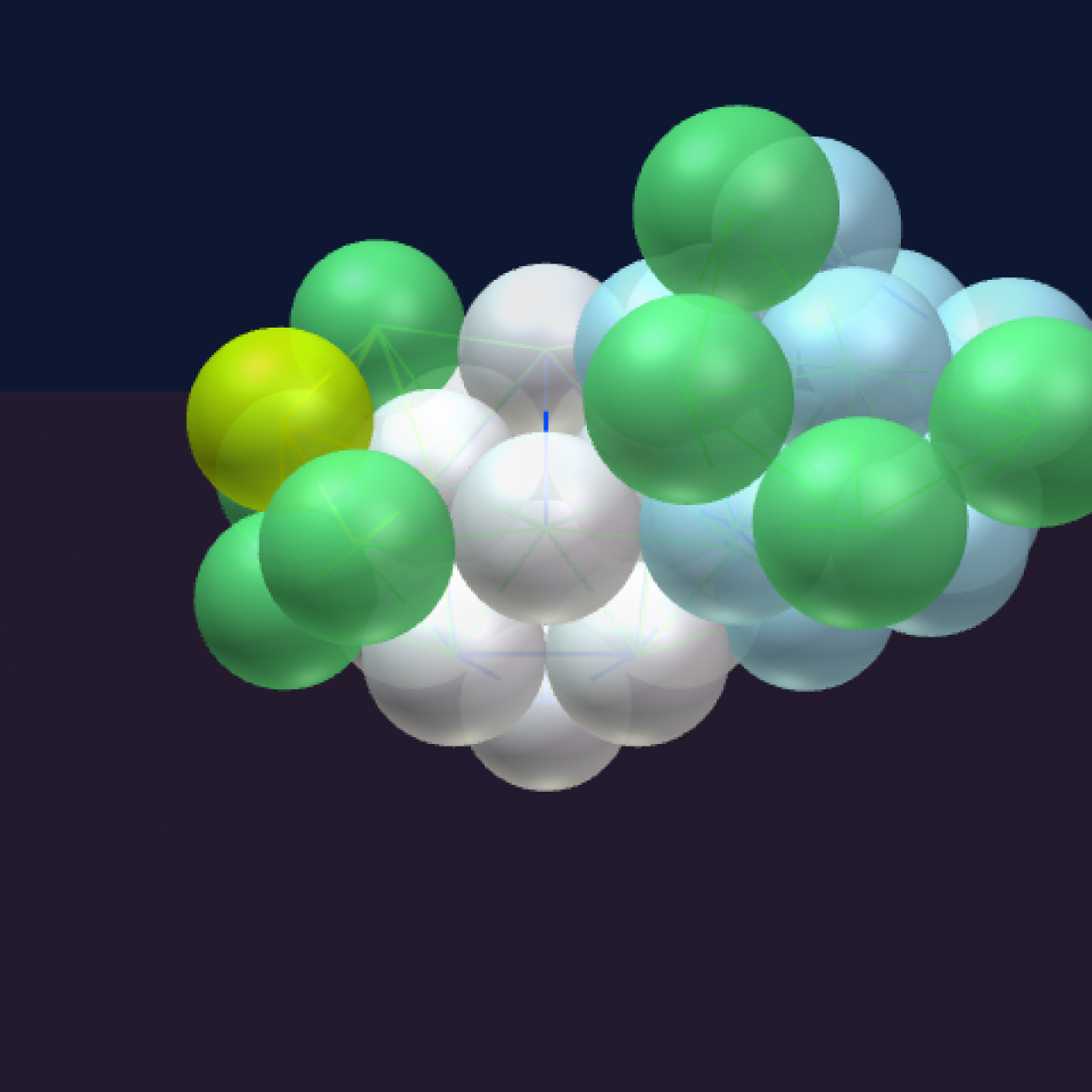
Sulfur 32

Atom Image
Image
sulfur-32.png
Name
sulfur-32
Width
480
Height
480
File size
141565
# Inner electrons
16
# Outer electrons
16
# Protons
32
Abundance
94.99
An-Isotope
16: 32
Approval
Public
BE - Actual
271.78
BE - Nucleon
8493.13
BE - SAM Lines
0.00
BE - SAM Lines %
0.00
BE - SAM Nuclets %
0.00
Element
Half Life
Stable
Mass Actual
31.97
Mass Calculated
32.25
Mass H Norm
31.72
SAM Lines
191.35
Stability

<p>Impossible!</p>

<p>This is a depiction of Sulfur that would be (more or less) the result of two Oxygen's fusing together creating the "expected" shape of what would be Sulfur that would have similar properties to Oxygen.</p>

<p>However this shape seems to be inherently unstable and would decay to the normal Sulfur element whereby the 5 ending would not be created, but these 5 protons would migrate during the formation of this element to the here shown 4 ending position.&nbsp;&nbsp;</p>

<p>This turns the initial ending that loses the protons into a Carbon nuclet and the neutral ending receiving the extra protons into a Boron nuclet.&nbsp;</p>

<p>See Sulfur 32&nbsp;</p>

Atomic Structure
N0:
state: final
protons:
P0:
P1:
P2:
P3:
P4:
P5:
P6:
P7:
P8:
P9:
P10:
P11:
P12:
P13:
P14:
P15:
neutrons: [U00]
nuclets:
N01:
state: initial
attachAngle: 3
protons:
P0:
P1:
P2:
P3:
P4:
P5:
P6:
P7:
P8:
P9:
P11:
P16:
P17:
P18:
P19:
Notes

<p>A suspected reason for the impossibility for this construct to exist is the fact that 2 Oxygens both have exact 8 pairs (D). Meaning a configuration with suddenly one "isolated" extra neutron is not a logical outcome because it would need to be separated from at least one proton which requires a different (hot fusion) process.</p>